Selecting your breast implants is one of the most important decisions you’ll make on your breast augmentation journey. Many patients wonder whether silicone or saline implants are better, but the real question concerns which is better for your body and goals. This blog will break down the pros and cons of both to help you figure out which one you gravitate toward so you can walk into your consultation feeling informed and ready to make an empowered decision.
5 Min Read:
Table of Contents
- What are saline and silicone breast implants?
- What are the pros and cons of saline implants?
- What are the pros and cons of silicone implants?
- What are gummy bear implants?
- Is one type of breast implant safer than another?
- Which implant is right for you?
What are saline and silicone breast implants?
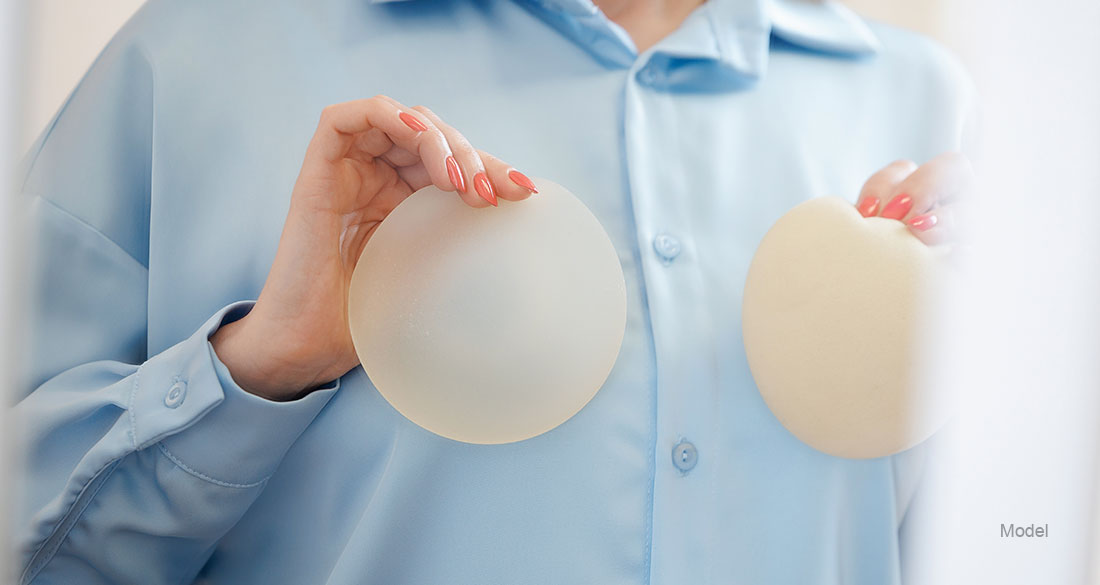
Both saline and silicone breast implants are FDA-approved devices used in breast augmentation and breast revision surgeries to enhance breast size, shape, and symmetry. They come in a wide variety of sizes, profiles, and shapes, allowing your surgeon to match the perfect implant to your body and goals.
The main difference between the two is what fills the implant:
- Saline implants are filled with sterile saltwater after the implant shell is placed.
- Silicone implants are pre-filled with a cohesive silicone gel before surgery.
- Gummy bear implants are just a special kind of silicone implant made of form-stable silicone that resembles the texture of a gummy bear when cut in half.
Both silicone and saline create excellent results for patients, and neither is universally “better” than the other. The right choice for you depends—how much natural breast tissue do you have? Are you seeking a very natural feel? What tradeoffs matter most to you?
What are the pros and cons of saline implants?
Saline implants have been used safely for decades. Many patients prefer them because they’re less expensive than silicone and require smaller incisions.
Pros of saline implants:
- Can be inserted through a smaller incision
- Filled after placement, so volume can be adjusted with more precision during surgery
- Immediate detection of rupture, as the saline is safely absorbed by the body and the breast visibly deflates
- Generally lower in cost than silicone implants
Cons of saline implants:
- A slightly firmer feel compared with silicone implants
- More likely to show visible rippling
- May have less natural movement
For patients with a moderate amount of natural breast tissue, saline implants can still provide beautiful results. However, patients seeking the softest, most natural feel often prefer silicone.
What are the pros and cons of silicone implants?
Silicone implants are the most popular choice today because many patients feel they provide a more natural feel and appearance.
Pros of silicone implants:
- Softer and more similar to natural breast tissue
- Less likely to show rippling under thinner breast tissue
- Tend to move more naturally with the body
- Excellent cosmetic results in patients with thinner breast tissue
Cons of silicone implants:
- Require a slightly larger incision
- Ruptures are usually “silent” and not immediately noticeable
- MRI or ultrasound imaging is recommended to monitor implant integrity
- Usually cost more than saline implants
For patients with less existing breast tissue, silicone implants have become the top choice due to their natural look and feel. Modern silicone implants also behave differently from older generations, with more cohesive gel fillings and multi-layer shells that are highly resistant to ruptures and leakage.
What are gummy bear implants?
Gummy bear implants are a highly cohesive form of silicone implant. They contain a firmer silicone that holds its shape more effectively than traditional silicone implants, much like a gummy bear candy holds its form when cut. If a gummy bear implant shell is damaged, the gel is less likely to leak out or migrate.
Some of the potential benefits of gummy bear implants include:
- Excellent shape retention for teardrop-shaped (anatomical) implants, which many breast reconstruction patients appreciate
- Increased safety due to reduced likelihood of leakage or gel migration if shell is damaged
- Lower risk of visible wrinkling and rippling
- Lower coincidence of capsular contracture
- Enhanced upper pole shape
Gummy bear implants aren’t automatically the best choice for everyone. Because they are more cohesive, they may feel slightly firmer than traditional silicone, which not everyone prefers. Still, they can be an excellent choice for patients seeking enhanced upper pole shape, those with thinner breast tissue, and patients seeking an implant known for higher longevity.
Is one type of breast implant safer than another?
Breast implant safety is understandably one of the most common concerns patients have when considering breast augmentation. Reassuringly, both saline and silicone implants have strong safety records and are approved by the FDA.
Modern breast implants undergo extensive testing and quality control before they reach the market. Complications such as rupture and capsular contracture can occur with any implant type, but advances in implant technology have improved outcomes over time.
Important points concerning breast implant safety:
- Saline rupture is usually obvious because the breast instantly loses volume.
- Silicone rupture is often silent and must be detected through imaging.
- Capsular contracture can occur with any type of implant.
- Implant rupture rates are low, and the likelihood of rupture increases gradually over many years of living with implants, which makes sense from a statistics standpoint.
You may have also heard about BIA-ALCL (breast implant-associated anaplastic large cell lymphoma). This is a rare condition primarily associated with textured implants, not with smooth saline or smooth silicone implants commonly used today.
Breast implant safety depends on multiple equally important factors:
- Choosing a qualified, experienced surgeon
- Proper surgical technique
- Appropriate implant selection
- Following postoperative instructions carefully
- Attending all follow-up appointments
In healthy patients, both saline and silicone implants are considered safe options when used appropriately and placed by a qualified, board-certified surgeon.
Which implant is right for you?
The best implant for you is the one that fits your body and your goals.
During a consultation, Dr. Goldschmidt evaluates several factors before making a recommendation, including:
- Your chest width, breast dimensions, and body proportions
- The amount of existing breast tissue
- Skin elasticity and quality
- Desired breast size and cleavage
- Athletic activity levels
- Preferences for a softer or more structured feel
- Long-term goals
For example, a very thin patient who wants a natural look may benefit most from silicone implants because they are less likely to ripple. A patient whose priority is peace of mind in the event of rupture may be best matched with saline implants. A patient who wants excellent shape retention may be a good candidate for gummy bear implants.
Implant selection should never be based solely on a friend’s experience or social media buzz. You deserve to be matched with the implant that’s perfect for you!
Interested in Breast Augmentation in Cleveland?
Choosing between saline and silicone implants is a question of which option will provide the safest, most satisfying results for you. Dr. Matt Goldschmidt can discuss your goals and lifestyle, and evaluate your anatomy to help you select the perfect implant.
To schedule your breast augmentation consultation, call The Cosmetic Surgery Center in Cleveland at (216) 264-8100 or complete our online contact form.